

Costa Rica, Family, Leadership, Learning a second language, Learning Spanish

What’s the return rate on an “experience?”

images copyIn a recent national poll with two choices – keep your current debt level or gain 25 pounds and have your debt erased, 72% of Americans said they’d rather keep the debt than put on the pounds.  A fascinating statistic considering the average household’s debt is 112% of disposable income.  So for most of us, vanity trumps financial peace of mind.  What other financial trade-offs might we be willing to make?

Here is one for consideration.  What percentage of your current savings would you give up to spend a one-year sabbatical, family experience abroad complete with rich learnings?  This question hits close to home for me as we are trying to capture the following things on our experience abroad.

For some context to answer this question here is some food for thought.

A one-year excursion to a foreign country is very expensive.  Without real intentionality and financial planning, it will never happen.  And all the advanced planning and budgeting still doesn’t ease the pain of seeing investment dollars (and Colones) go through the drain (especially while the faucet is temporarily shut off).  There are the cash costs such as school, rent, a car, monthly expenses abroad, monthly expenses back home, etc.  Add on top of this new foregone savings (you don’t really give up salary on a sabbatical, only the savings/investment that would have resulted from that salary).

Assessing the value of an abroad experience is very difficult. It’s kind of an expense and it’s kind of an investment, but not exactly either.  Keep in mind that there will be storms along the way, so your notion of the “experience value” will likely shift throughout the experience and well after.  And the value placed on a particular experience will vary by as many people as you ask, so perhaps consider the questions below:

  • What would be the value to you in reclaiming a year with your oldest kids?
  • How about the value of your family knowing a second language and culture?
  • How about the value of personal reflection time vs. a never-ending to-do list?
  • How about the value of pursuing and mastering a long-desired hobby?
  • How about completing all of the above things at the same time?
  • Are you ready to weather the storms that come during the experience?

In our current situation, the immediate costs are much easier to determine than the collective long-term benefits, which makes the process a struggle at times.  Regardless, this was our dream and our gut feel is that it will pay off in many multiples over time, and likely even in some unexpected ways.

Entrepreneurship, Leadership, Learning Spanish, Start-up Failures, Start-ups

Start-up failures I’ve witnessed

It’s no secret that most start-ups fail and become painful financial lessons.  I recently wrote about the themes of my past successful ventures (Got some start-up ideas in mind?).  On the opposite side of the equation, I’ve seen some common themes in start-up failures where I’ve had a front row seat as a witness.

Lots of people continue to pursue start-ups.  According to CNN Money, 340 of every 100,000 adults launch a business each month, creating 565,000 start-ups monthly.  Incidentally, immigrants (particularly Latinos) at 560/100,000 people, are almost twice as likely as Americans born in the US to launch their own business.  Learning Spanish is becoming increasingly important (Why we moved to Costa Rica for a year).

While the aggregate statistics are interesting, my perspective below is based on a much smaller world of friends and acquaintances that have started a business.  Typically, this involves making the jump from W2-earning corporate life and partnering with one or more people to pursue a start-up.  In no particular order, here are the most common drivers of failure I’ve observed:

  • Legal steps, such as detailed operating agreements are overlooked or delayed.  When I hear someone tell me “it’s not a problem, we are good friends and we’ll get all the legal stuff done later on” or something of that nature, it feels like one of the few times in my life when I can really predict the future.  Spend the time and the money on professional advice, as it will protect the business and the friendship.
  • The business is based on a personal passion with no real understanding of the economic engine or the practical implications of running the business.  Not to be confused with passion plus capability plus a good business model, which is a great combination.
  • The focus is on a remote probability business (albeit with a potentially large payoff).  When the overwhelming majority of your success is out of your control that is a hard business.  When you are trying to create demand vs. fill demand that is a hard business.
  • The cash flow is not managed or even worse, not really understood.  To say “cash is king” is a “master of the obvious” type statement, but it’s amazing how many people get into a business and don’t understand it, or for that matter, the differences between gross and net sales, gross and variable and net margins, etc.  If you (or your partners) don’t understand these concepts from some level of experiential knowledge, be careful throwing money into a start-up.
  • The exit options (I.e., beyond annual salary and/or distributions, how do you monetize this thing at some point via a sale or public offering) are not considered at the outset or actively managed along the lifespan of the business.  When you are simply ready for a new challenge, or there is a business downturn or a bump elsewhere in your personal life, if you haven’t already determined how to exit, it won’t happen.  As coach John Wooden said, “When opportunity (or presumably tragedy) comes, it’s too late to prepare.”

What are the most common (and possibly avoidable) reasons for start-up failures you’ve observed first-hand or experienced first-hand? 

What might be just as sad as a start-up failure is a great start-up idea that simply dies a dream.  Most of the conversations I’ve had with friends and acquaintances regarding potential start-ups land in this scenario.  More thoughts on the reasons for this in a later entry.

Costa Rica, Family, Learning a second language, Learning Spanish

Learning Spanish is like being in a coma…

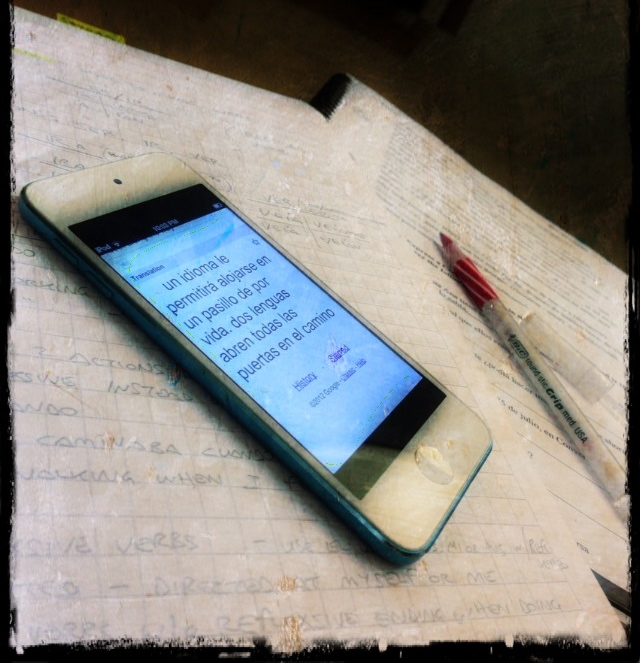
IMG_2350… I’ve read that many people who have woken up from comas claim they could hear and understand the things being said around them, but simply couldn’t respond vocally or physically.  This is crudely similar to my Spanish abilities after one month of immersion school at Conversa.  I comprehend much of what I hear – I just find it impossible to speak the language most of the time.

My Spanish abilities hierarchy is as follows: (1) When reading I comprehend Spanish pretty well.  (2) When listening (and if spoken slowly) I can understand it fair to good.  (3) However, forming a childlike sentence and saying it with confidence can be incredibly difficult and frustrating.  I am equally frustrated to learn just how much English grammar I have forgotten – does anyone over 40 not presently employed as an English teacher remember exactly what are indirect objects, past participles, future perfect tenses, etc.?

In short, learning a new language is very difficult.  And, I am blessed to have the means (i.e., the time off and the money to afford) for immersion school.  I have a newfound empathy for people in the US who cannot speak English and will certainly have an altered perspective the next time I hear someone utter “Speak the language (i.e., English) or leave the country.”  For most people trying to learn a second language in even the best of circumstances, it simply isn’t that easy.

So, how much of a new language can one really master in one year?  In one of my favorite books, “Outliers”, Malcolm Gladwell (http://www.gladwell.com) discusses the need to invest 10,000 hours in a trade or activity to reach expert status. I’m currently investing in six weeks of immersion school at seven hours a day for five days each week. This equates to 210 hours of Spanish or roughly 2% of the necessary time needed to reach expert status.  Barely a dent.  In the 354 days I have remaining in Costa Rica, I would need to invest:

  • 27 hours per day to reach 10,000 hours (i.e., Expert) – not possible
  • 14 hours per day to reach 5,000 hours (i.e., Fluent?) – not likely
  • 6.5 hours per day to reach 2,500 hours (i.e., ?) – possible with real dedication

In short, truly learning a second language while living your life in your primary language seems impossible to me.  We are fortunate to be learning Spanish while living in a Spanish-speaking community and we are trying to break the pattern of speaking English while in our home, but old habits die hard.

I’m hopeful the immersion classes truly kick-start the speaking process for my whole family (by the way, I highly recommend http://www.conversa.com).  We debated spending the summer relaxing and getting settled and then trying to begin the language process – vs. spending seven+ hours a day with our brains in overdrive.  But we were reminded of something said by our friend (and pastor) Kevin Myers about training endurance vs. trial endurance – “If you don’t endure the training, you will be forced to endure the trials.”  This statement is true and applicable far beyond language training to personal finance, relationships, etc.  Regardless, we opted to endure the training to minimize the longer-term trials.

Recently, I’ve come across many Costa Ricans who have been patient and understanding as I fumbled for simple words.  I felt foolish and frustrated but their kind expressions and encouragement were a real shot in the arm.  In contrast, I’ve come across other people who were clearly frustrated by my lack of Spanish and I suspect we both left the interaction a bit worse than we entered it.

So … the next time you come across someone who is struggling with English, please be patient and be an encourager.  Remember, what they are trying to do is really hard.

How was your experience learning a second language?  Any tips?