Faith, Family, Fatherhood, God, Parenting

Don’t make me come down there! (and other lessons God might be teaching us through parenting)

Me and my little girls

Me and my little girls

The statement “there is no better or harsher corrective to one’s thinking about human transformation and development than one’s children” is so true at times.  As we wind our way through parenting our children, it is easy to envision God looking down at us, the parents, and shaking his head at the irony of how often we miss the lessons we attempt to teach.  I assumed I might find a book or a series of articles on this topic, but could not, so I thought I’d share a few I’ve collected over time.  Where I can recall a direct source for the metaphor it is attributed.

If you believe in God you might identify with some of this content.  Even if you are unresolved spiritually or don’t believe in God, but are a parent you might identify with some of this content.  For me personally, many of the below examples hit closer to home than I would like.

Situation: You are driving in the car and your children are arguing in the backseat about something that is completely trivial.  You respond with something along the lines of “Don’t make me stop this car and come back there.”  Lesson: How often must God look down at us arguing over denomination issues, biblical interpretation issues, inter-family issues, etc. – where we are certain it is more critical to be right than to simply show love to each other – and think, “Don’t make me come down there.”  Metaphor from a Craig Groeschel message.

Situation: Two of your young children are fighting over who gets to cuddle with you (or run an errand, do something fun, etc.).  Before you want to do the fun thing with either of them you want them to reconcile with each other, and if they are not willing, you don’t really want to give either of them any special time.  Lesson: How often do we go to God with prayer, concerns, questions, etc. when we have unresolved conflict in our life?  How often must God look upon us and think first apologize to those you have wronged and then come to me?  Metaphor from a Craig Groeschel message.

Situation: You have bought your child something to eat – candy, popcorn, whatever.  You innocently reach over to grab a bite or a handful and your gesture is met with groans or screams.  Your first instinct is to say “I gave it to you and you can’t share just a little?”  Lesson:  My first instinct is way too often that what is mine is really mine.  It is easy to envision God shaking his head thinking “I gave it to you and you can’t share just a little bit???”  Metaphor from a Kevin Myers message.

Situation:  Think back on the birth of your first child.  Remember looking down at that little girl you just saw for the first time and thinking you would lay down your life for her, that you loved her more than you could describe, etc.  And the truth is that she had done nothing to be deserving of your love and affection.  Lesson: It is easy to forget that God loves each of us to an even greater degree than we can comprehend; despite the fact that we have done nothing to deserve it and way too often actively rebel against it.

Situation: You witness your child do something nice or selfless for someone else.  Your heart gets filled in an amazing way and you find yourself wanting to lift up your child in some positive way.  Lesson:  God lifts up those that lift up others.  Every day I am confronted with many situations where my simple response can lift someone up or bring them down, bring more love into the world or more anger, etc.  I get so proud when I see my kids make the obvious choice – it’s too bad that in a hurry or frustration or whatever other emotion, that I too often make the wrong choice.

Situation:  Your child wants an additional privilege or responsibility and one of the first thoughts through your head is “you haven’t even done a good job with the other stuff you are responsible for, why would I give you more?”  And that once they have proved themselves, you’ll consider their new request.  Lesson:  How often do we want to expand our earnings, our influence, etc. when we have failed to truly be a good steward of our present situation?  It is easy to see God looking down in frustration saying, “please take care of this first and then we can consider something new.”

Situation: You are observing your young child trying to do something difficult – e.g., assembling a new toy.  He or she gets frustrated but continues on without asking for help and their frustration grows along the way.  You think, “I am right here, you just have to ask for my help.”  Lesson:  How often must God see us struggling, living in frustration, and think “I am right here – why don’t you ask me for help?”  Metaphor from a Ken Coleman podcast.

The above sampling is just scratching the surface of real life examples that are easy to see with a bit of reflection – I can only imagine how deep this list will be for me once I’ve survived the teenage years with my kids.  I’d encourage you to look for similar metaphors in your life that you can see in your parent/child relationship.  Sometimes the pause for reflection can lead to real life change.

So, what lessons do you find yourself trying to teach your kids, that perhaps God would say you might need to listen to as well?

Faith, Journaling, Leadership, Parenting, Quotes

Are You Not Inspired?…

Bruce-LeeEveryone loves meaningful and/or inspiring quotes.  People hang great quote signs on their walls or post them on Facebook.  I tend to write quotes that really grab me in my journal and reference them often in work situations, small groups, personal interactions, etc.

If you Google “great quotes” you’ll get 722M results.  The same action with “inspiring quotes” and “leadership quotes” yields 47M and 70M, respectively.

I looked back through hundreds of quotes in my journal to find those most meaningful to me.  I tried to narrow down to those quotes that go beyond offering a temporary burst of inspiration, but rather have led to real changes in my behavior.   In no particular order here is my list, which could broadly be categorized by leadership, business, family and faith (and many of the quotes go across multiple categories).

“Something is fundamentally dismantling when you say the right things but have the wrong actions.  That is, talk like a leader, but act like an anchor.”  Kevin Myers I find this quote applicable in work, family, friendship and faith.

“When those who are the closest to you and know you the best, love and respect you the most.” John Maxwell on the definition of success.  This quote has greatly reshaped how I think about the question “what is success?”

 “Quality time comes at the most unusual moments.  You never know when it will happen.  It usually makes an appearance somewhere in the realm of quantity time.”  Steve Farrar.   This quote always reminds me to be present with my family.

“Every time you make a choice you are turning the control part of you, the part that chooses, into something a little different from what it was before.  And taking your life as a whole, with all your innumerable choices, you are slowly turning this control thing either into a heavenly creature or a hellish creature.”  CS Lewis.  Lewis was a master of packing deep content into everything he wrote.

“My fully exploited strengths will always offer more to the organization than my marginally enhanced weaknesses.”  Andy Stanley.  I find I most often apply this quote in a business environment.

“It’s the Holy Spirit’s job to convict, God’s job to judge and my job to love.”  Billy Graham This quote all to frequently reminds me that I focus too much on the two former jobs and not enough on the latter one.

“Idealism increases in direct proportion to one’s distance from the problem.”  John Galsworthy.  Anyone who has worked for a large company and takes direction from afar is familiar with this.  So is a stay-at-home mom trying to manage a household with a traveling husband’s input.

“Someone living close to us will take no notice of any attempts to tell them about Christ if our lives are not demonstrating the truth of the message we claim to believe.”  Unknown.  A constant gut check for how I am living.

“Materialism begins where your income ends.”  And “Envy begins where your influence ends.”  Ed Young (I believe?).  Who came into your mind first? How often do we simply need to look in the mirror?

 “I doubt when I get all hung up on what is unexplainable and lose sight of what is undeniable.”  Andy Stanley Just a great quote on doubt and faith.

“A good apology has three components.  (1) It’s specific. (2) Forgiveness is asked for. (3) There is no whining about the consequences.”  Craig Groeschel.  My children can quote this one too by now!

“God, let me make a difference for you that is utterly disproportionate to who I am.”  David Brainerd A great quote to help me think bigger about what I might offer.

Someday is a disease that will take your dreams to the grave with you.”  Tim Ferriss I have many friends who have contemplated leaving corporate America and becoming entrepreneurs.  Many suggest the timing isn’t right but it will be someday.  When the right timing keeps getting pushed out, this quote often comes to mind.

“The moment you feel the need to tightly manage someone, you probably made a hiring error or a seat error.”  Jim Collins I constantly apply this quote in the work environment.

“The interest rate on culture debt is crushingly high.”  Unknown This thought goes through my head any time I’m hiring someone, especially in a small company environment where one wrong hire can tank the entire culture.

Incidentally, none of the quotes in my list appear in the Top 100 Inspirational Quotes as determined by Forbes and Quoto.  Regardless, I hope some of these inspire you and you find a place to apply them in your life.

What are your favorites quotes (i.e., the real difference makers) and why?

Costa Rica, Family, Fatherhood, Parenting

Unable to outsource my family!!!

photo copyAlmost every year at the end of the school year, as kids’ school activities dominate my wife’s calendar, I remember hearing her say “I can’t wait for school to be over!” It seemed we were only a week or two into summers when I remember her saying “I can’t wait until school starts!”

When routines are changed and much more time is spent together, annoying behaviors and characteristics tend to become amplified.  This got me thinking about all of the ways we outsource our children, families, relationships, etc. – oftentimes to compensate for certain behaviors or to simply avoid them.  While there are corresponding positives of each of the following bullets, here are some ways we (i.e., the McNeills) outsource our kids and ourselves:

  • Our girls’ sports occupy a lot of their time.  No doubt they learn great lessons, make friends, have fun, etc.  Sometimes we find ourselves hoping it will simply serve to burn off energy so they will go to bed early.
  • Our girls have a lot of play dates at home or at their friends’ homes.  When they are engaged with friends, they tend to be more out of our hair.
  • Our girls zone out with technology. For them, this means watching YouTube videos, making Video Star videos or posting pics on Instagram.
  • Our girls each have their own room at home and can disappear from the rest of the family whenever they want.
  • We get together with other couples that also have kids. All the kids play together and the couples hang out, or the men talk while the ladies talk. Even though we are together, we are often really apart as the same time.
  • My wife and I both have our own personal outlets (e.g., tennis, working out, etc.) where we are on our own and away from our family.

Our outsourcing recently came to an end as we’ve literally spent the whole summer together. We have eaten every meal together and shopped most grocery runs as a family.  When we’ve done pretty much anything we’ve done it together.  With the exception of a bit of technology, all of the above bullets have been absent from our lives this summer. It’s been interesting, eye-opening, frustrating, great, annoying, etc. – often all at the same time.  Here is what we are learning and experiencing:

  • Certain character traits (of myself, my wife and all four daughters) that were perhaps in the shadows but managed via outsourcing are now front and center, and we have no choice but to address them.
      • We’ve talked a lot around the table about how these behaviors detract from the family.  Eating breakfast, lunch and dinner together is a great platform for family discussions.  We’ve lingered at the end of meals and just talked and laughed.  It might have only been possible because none of us had anywhere else to go, but that doesn’t really matter. The moments and associated lessons still occurred.
      • We are making each girl room with each sister for four months during our twelve-month stay.  It was awesome when the two girls with the most combative relationship huddled together to make a list of rules they’d try to live by in order to get along better while rooming.
  • Having individual outlets is really important for our family. For my wife and I, it helps build an appreciation for other family members when we are without them. It makes us miss our girls more.  When we get to engage in personal pursuits that we enjoy, we are more inclined to proactively help them do things they want to do.  After a summer without any individual outlets, we are very ready to reintroduce some into our lives.
  • We learn a lot from socializing with other families.   We’ve got some great friends at home that are great role models as spouses and parents.  We pick up insights all the time that we try to apply in our own lives.  It is more difficult now that we are largely winging it on our own, but luckily we are starting to meet some new friends that can hopefully help fill this void.
  • All of us are a bit more selfish than we should be.  A few years ago, Kevin Myers mentioned, “The magic of family is in sacrifice.  Are you silently sacrificing or silently selfish?” A few small instances of sacrifice go such a long way that it amazes me that continual sacrifice is not intrinsically built into my DNA and that I have to constantly remind myself to do this.

Sometimes when your circumstances change, the silent sacrifice or silent selfishness becomes a loud boom that everyone can hear.  Perhaps a large reset is good for all of us to experience every now and then to bring things to the surface and allow for real reflection and addressing.

Costa Rica, Family, Learning a second language, Learning Spanish

Learning Spanish is like being in a coma…

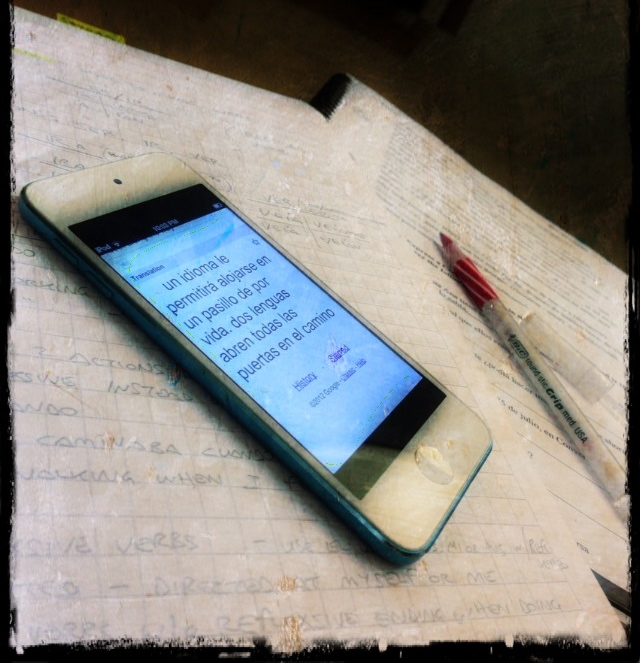
IMG_2350… I’ve read that many people who have woken up from comas claim they could hear and understand the things being said around them, but simply couldn’t respond vocally or physically.  This is crudely similar to my Spanish abilities after one month of immersion school at Conversa.  I comprehend much of what I hear – I just find it impossible to speak the language most of the time.

My Spanish abilities hierarchy is as follows: (1) When reading I comprehend Spanish pretty well.  (2) When listening (and if spoken slowly) I can understand it fair to good.  (3) However, forming a childlike sentence and saying it with confidence can be incredibly difficult and frustrating.  I am equally frustrated to learn just how much English grammar I have forgotten – does anyone over 40 not presently employed as an English teacher remember exactly what are indirect objects, past participles, future perfect tenses, etc.?

In short, learning a new language is very difficult.  And, I am blessed to have the means (i.e., the time off and the money to afford) for immersion school.  I have a newfound empathy for people in the US who cannot speak English and will certainly have an altered perspective the next time I hear someone utter “Speak the language (i.e., English) or leave the country.”  For most people trying to learn a second language in even the best of circumstances, it simply isn’t that easy.

So, how much of a new language can one really master in one year?  In one of my favorite books, “Outliers”, Malcolm Gladwell (http://www.gladwell.com) discusses the need to invest 10,000 hours in a trade or activity to reach expert status. I’m currently investing in six weeks of immersion school at seven hours a day for five days each week. This equates to 210 hours of Spanish or roughly 2% of the necessary time needed to reach expert status.  Barely a dent.  In the 354 days I have remaining in Costa Rica, I would need to invest:

  • 27 hours per day to reach 10,000 hours (i.e., Expert) – not possible
  • 14 hours per day to reach 5,000 hours (i.e., Fluent?) – not likely
  • 6.5 hours per day to reach 2,500 hours (i.e., ?) – possible with real dedication

In short, truly learning a second language while living your life in your primary language seems impossible to me.  We are fortunate to be learning Spanish while living in a Spanish-speaking community and we are trying to break the pattern of speaking English while in our home, but old habits die hard.

I’m hopeful the immersion classes truly kick-start the speaking process for my whole family (by the way, I highly recommend http://www.conversa.com).  We debated spending the summer relaxing and getting settled and then trying to begin the language process – vs. spending seven+ hours a day with our brains in overdrive.  But we were reminded of something said by our friend (and pastor) Kevin Myers about training endurance vs. trial endurance – “If you don’t endure the training, you will be forced to endure the trials.”  This statement is true and applicable far beyond language training to personal finance, relationships, etc.  Regardless, we opted to endure the training to minimize the longer-term trials.

Recently, I’ve come across many Costa Ricans who have been patient and understanding as I fumbled for simple words.  I felt foolish and frustrated but their kind expressions and encouragement were a real shot in the arm.  In contrast, I’ve come across other people who were clearly frustrated by my lack of Spanish and I suspect we both left the interaction a bit worse than we entered it.

So … the next time you come across someone who is struggling with English, please be patient and be an encourager.  Remember, what they are trying to do is really hard.

How was your experience learning a second language?  Any tips?